A comprehensive guide for patients considering root canal treatment in Qatar
Few dental procedures carry as much unwarranted fear as root canal treatment. For decades, it has been the subject of jokes, horror stories, and avoidance — yet modern root canal therapy, performed by a skilled endodontist with contemporary techniques and anaesthesia, is no more uncomfortable than having a filling placed. In fact, the pain that drives patients to seek root canal treatment is far worse than the treatment itself.
This guide explains exactly what root canal treatment involves, why it is necessary, what it costs in Qatar, and how Qatar Prime Dental Center's one-session root canal technique delivers complete treatment in a single appointment — a significant advantage over the multi-visit approach still used by many clinics in Doha.
What Is Root Canal Treatment?
Inside every tooth, beneath the hard enamel and dentine, lies a soft tissue called the pulp. The pulp contains nerves, blood vessels, and connective tissue that help the tooth grow during development. Once a tooth is fully mature, it can survive without the pulp because it continues to be nourished by the surrounding tissues.
Root canal treatment (also called endodontic treatment) is the process of removing infected, inflamed, or dead pulp tissue from inside the tooth, cleaning and shaping the root canals, and sealing them to prevent re-infection. The tooth is then restored with a crown or filling to protect it and restore full function.
When Is Root Canal Treatment Necessary?
Root canal treatment is required when the pulp becomes infected or irreversibly inflamed. This typically occurs as a result of:
- Deep decay: A cavity that has progressed through the enamel and dentine to reach the pulp.
- Cracked or fractured tooth: A crack that extends into the pulp, allowing bacteria to enter.
- Repeated dental procedures: Multiple fillings or procedures on the same tooth can irritate the pulp over time.
- Trauma: A blow to the tooth can damage the pulp even without visible external damage.
- Gum disease: Advanced periodontitis can allow bacteria to enter the root canal through the apex of the root.
Warning signs that you may need root canal treatment:
- Severe, persistent toothache — especially when biting or applying pressure
- Prolonged sensitivity to heat or cold (lasting more than a few seconds after the stimulus is removed)
- Darkening or discolouration of the tooth
- Swelling or tenderness in the nearby gums
- A persistent pimple-like bump on the gums (a dental abscess)
It is important to note that in some cases, an infected tooth shows no symptoms at all. This is why regular dental check-ups with X-rays are essential — early detection allows treatment before the infection spreads and causes more serious complications.
Root Canal Treatment Costs in Qatar: Current Price Guide
The cost of root canal treatment in Qatar depends primarily on which tooth is being treated. Teeth at the back of the mouth (molars) have more root canals and are more complex to treat, commanding a higher fee.
| Tooth Type | Number of Canals | Price Range (QAR) | |---|---|---| | Front tooth (incisor/canine) | 1 canal | 1,200 – 2,000 | | Premolar | 1–2 canals | 1,500 – 2,500 | | Molar | 3–4 canals | 2,000 – 3,500 | | Retreatment (previously treated tooth) | Varies | 2,500 – 4,500 | | Crown (required after root canal) | — | 1,500 – 3,500 |
Note: These are indicative ranges for specialist endodontists in Qatar. A crown is typically required after root canal treatment to protect the weakened tooth structure.
One-Session Root Canal Treatment: Qatar Prime Dental Center's Approach
Traditionally, root canal treatment required 2–3 appointments spread over several weeks. The first appointment involved opening the tooth and placing a medicated dressing; subsequent appointments completed the cleaning, shaping, and filling of the canals.
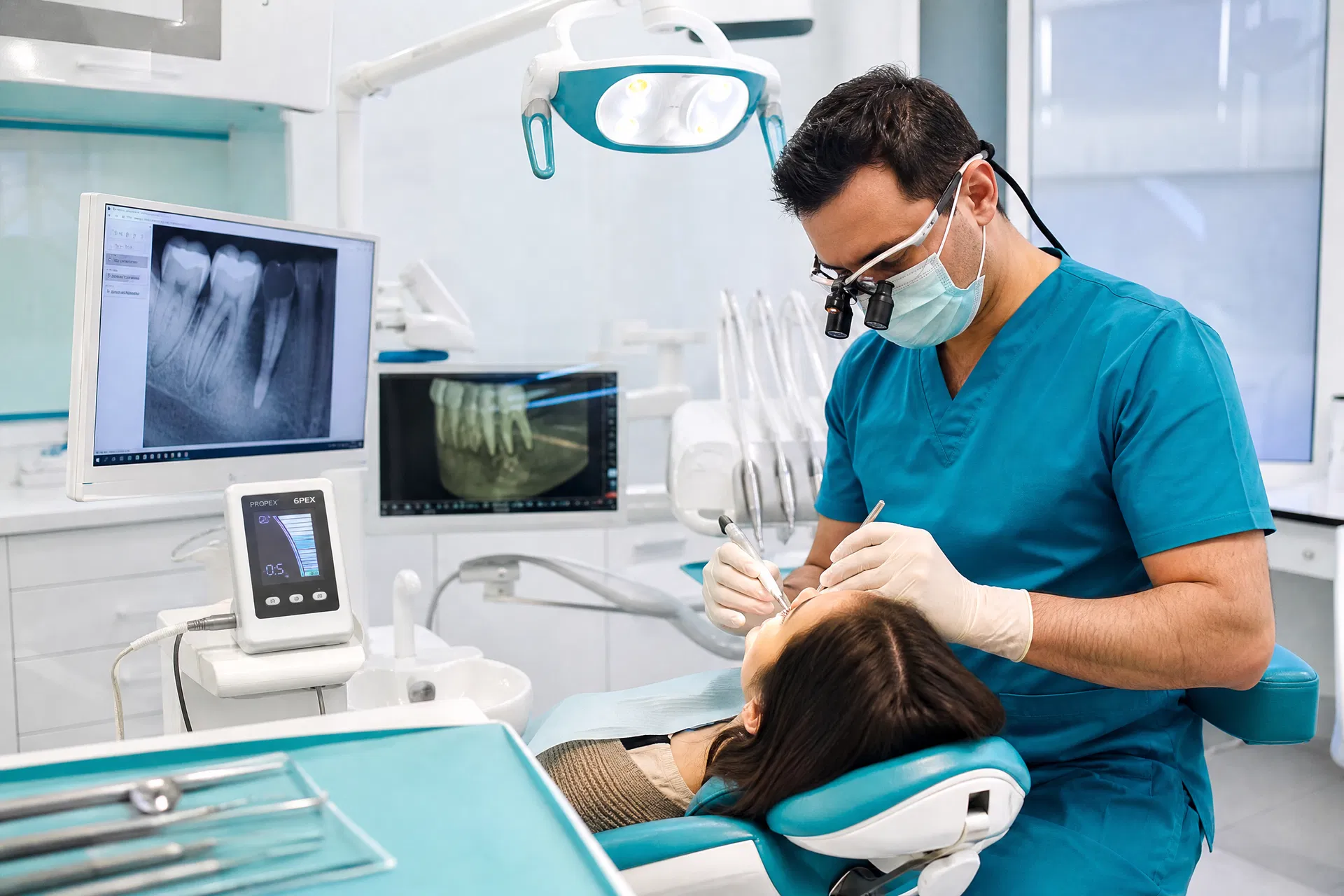
At Qatar Prime Dental Center, root canal treatment is completed in a single session using advanced rotary endodontic instruments and apex locators that allow precise, efficient canal preparation in one visit. This approach offers several advantages:
- Less time off work: One appointment instead of three.
- Faster pain relief: The source of infection is eliminated in a single visit.
- Reduced risk of re-contamination: The tooth is sealed immediately, preventing bacteria from re-entering between appointments.
- Equivalent outcomes: Clinical evidence supports single-visit root canal treatment as equally effective as multi-visit approaches for most cases.
The one-session technique is performed by Qatar Prime Dental Center's specialist Endodontists — Dr. Wajih El Hajj and Dr. Chadi Tarbay — who have dedicated training and extensive experience in root canal therapy.
Is Root Canal Treatment Painful?
This is the question every patient asks, and the honest answer is: no, not with modern anaesthesia and technique.
The procedure is performed under local anaesthesia, which completely numbs the tooth and surrounding area. Most patients feel nothing more than the initial injection (which itself can be made virtually dental anxiety with topical anaesthetic applied beforehand). The sounds and sensations of the procedure — vibration, pressure, water — are present, but pain is not.
For patients with severe dental anxiety, Qatar Prime Dental Center offers root canal treatment under intravenous sedation or general anaesthesia — a service supervised by Dr. Johnny Aoun, who has over 30 years of experience with dental procedures under general anaesthesia. This option is available for both adults and children.
Post-operative discomfort is typically mild and manageable with standard over-the-counter pain medication. Most patients return to normal activities the same day.
What Happens After Root Canal Treatment?
Once the root canals are cleaned and sealed, the tooth needs to be restored to protect it from fracture and restore function. In most cases, this means placing a dental crown.
A tooth that has undergone root canal treatment is more brittle than a living tooth because the pulp, which provided moisture and nutrients to the dentine, has been removed. Without a crown, the tooth is at risk of cracking under normal biting forces — particularly for back teeth that bear the brunt of chewing. Qatar Prime Dental Center's Prosthodontic team, led by Dr. Adib Nawar, provides same-clinic crown fabrication, minimising the number of appointments required.
Root Canal Treatment vs. Tooth Extraction: Which Is Better?
When a tooth is severely infected, patients sometimes ask whether it is better to simply extract it rather than invest in root canal treatment. In most cases, saving the natural tooth is the better long-term decision:
| Factor | Root Canal + Crown | Tooth Extraction | |---|---|---| | Preserves natural tooth | Yes | No | | Bone preservation | Yes | No (bone loss begins) | | Adjacent teeth affected | No | May shift into gap | | Replacement needed | No | Yes (implant or bridge) | | Long-term cost | Moderate (one-time) | Higher (extraction + implant) | | Treatment time | 1–2 appointments | 1 appointment + months for implant |
Extracting a tooth and leaving the gap leads to bone loss, shifting of adjacent teeth, and bite changes that can cause further dental problems. Replacing the tooth with an implant is the appropriate solution after extraction, but the total cost (extraction + implant + crown) is typically higher than root canal treatment and a crown.
Why Choose Qatar Prime Dental Center for Root Canal Treatment?
- Specialist Endodontists: Dr. Wajih El Hajj and Dr. Chadi Tarbay bring dedicated endodontic training to every case.
- One-session treatment: Complete root canal therapy in a single appointment — no multiple visits required.
- Advanced technology: Rotary endodontic instruments, electronic apex locators, and 3D X-ray imaging for precise treatment.
- calm approach: Topical anaesthetic before injection, advanced local anaesthesia techniques, and sedation options for anxious patients.
- General anaesthesia option: For highly anxious patients or complex cases, root canal treatment can be performed under general anaesthesia — a unique capability in Qatar.
- Same-clinic crown fabrication: Prosthodontic team available in-house for seamless post-endodontic restoration.
- Established since 2012: More than 14 years serving Doha with comprehensive dental care.
Frequently Asked Questions
How long does a root canal take? With Qatar Prime Dental Center's one-session technique, most root canals are completed in 60–90 minutes. Complex cases with multiple canals or curved roots may take up to 2 hours.
How long do root canal-treated teeth last? A root canal-treated tooth with a well-fitted crown can last a lifetime with proper oral hygiene and regular check-ups. Studies show success rates of 85–95% at 10 years for properly performed root canal treatment.
Can I eat after root canal treatment? You should avoid eating until the anaesthesia has worn off to prevent accidentally biting your cheek or tongue. Once the numbness has resolved, you can eat normally, though it is advisable to avoid very hard foods on the treated tooth until the crown is placed.
What happens if I don't get root canal treatment? An untreated infected tooth will not heal on its own. The infection will spread to the surrounding bone and potentially to other teeth, the jaw, or — in severe cases — other areas of the body. The tooth will eventually need to be extracted. Early treatment is always preferable.
Can a tooth that has had root canal treatment get infected again? In rare cases, a root canal-treated tooth can become re-infected if the seal is compromised, a new crack develops, or the original treatment was incomplete. Retreatment or extraction may be required. This is why a crown and regular check-ups are important after root canal treatment.
Book Your Root Canal Consultation in Doha
If you are experiencing tooth pain, sensitivity, or swelling, do not delay — early treatment prevents the infection from spreading and saves the tooth. Book your appointment at Qatar Prime Dental Center today for a comprehensive assessment with our specialist Endodontists.
Qatar Prime Dental Center — Zone 55, Street 1, Villa 13, Doha, Qatar | +974 33823222 | info@qatarprimedental.com
Note: Instagram doesn't support direct link sharing. Copy the link and paste it into your Instagram story or bio.